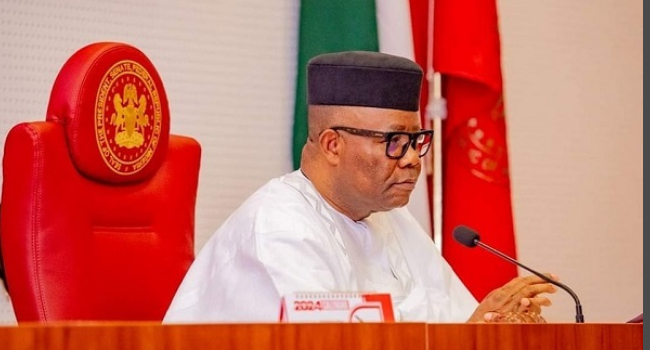
The Senate is set to hold an emergency plenary session on Tuesday amid growing controversy over proposed amendments to the Electoral Act, particularly the provisions on electronic transmission of election results.
The emergency sitting was announced in a notice issued on Sunday by the Clerk of the Senate, Emmanuel Odo, following a directive from Senate President Godswill Akpabio.


According to the notice, the session is scheduled for noon at the Senate Chamber. Although no official reason was stated, the development comes against the backdrop of public backlash and protests over the Senate’s passage of the Electoral Act 2022 (Repeal and Re-enactment) Amendment Bill 2026 through a third reading last week.
The controversy centres on Clause 60, Subsection 3, of the bill, which deals with the electronic transmission of election results. The Senate declined to adopt a proposed amendment that would have made real-time electronic transmission mandatory, opting instead to retain the existing provision in the 2022 Electoral Act.
The retained clause states that the presiding officer shall transfer election results, including the total number of accredited voters and ballot results, in a manner prescribed by the Independent National Electoral Commission.
The rejected proposal would have required INEC presiding officers to electronically transmit polling unit results to the IREV portal in real time after the result forms had been duly signed and stamped. The Senate also turned down a proposal to impose a 10-year ban on vote-buyers, choosing to maintain the current penalties of fines and imprisonment.
Public discontent over the Senate’s decision spilled onto the streets on Monday, as civil society groups and opposition parties staged the “Occupy National Assembly” protest at the entrance of the complex in Abuja.

The protest drew a heavy security presence, with personnel from the Nigeria Police Force, the Nigerian Army and the Nigeria Security and Civil Defence Corps deployed around the area. Security operatives barricaded the main entrance to the National Assembly, though protesters said they had no plans to force their way into the complex.
Among those who joined the protest was the 2023 Labour Party presidential candidate, Peter Obi, now a member of the African Democratic Congress. Obi urged lawmakers to make real-time electronic transmission mandatory to prevent a repeat of the technical challenges experienced during the 2023 general elections.
In response to the backlash, Senate President Akpabio clarified that the Senate did not reject electronic transmission, but merely retained the existing provision in the 2022 law.
Speaking at a book launch over the weekend, he said the phrase “real time” was removed to avoid possible legal complications in the event of network failures.
According to him, the decision was meant to give INEC flexibility to determine the most suitable method of transmitting results, taking into account technological and security challenges.
Former Senate President David Mark also weighed in on the issue, urging the National Assembly to allow INEC decide whether or not to transmit results electronically.
Despite the criticism, some lawmakers have defended the bill. Senator Victor Umeh of Anambra Central said more than 85 per cent of senators supported electronic transmission, adding that the only adjustment made during the executive session was the removal of the phrase “in real time” due to network concerns.
He explained that confusion arose during plenary when a motion was reportedly introduced to replace the word “transmission” with “transfer” without debate, a move he said contradicted earlier deliberations.