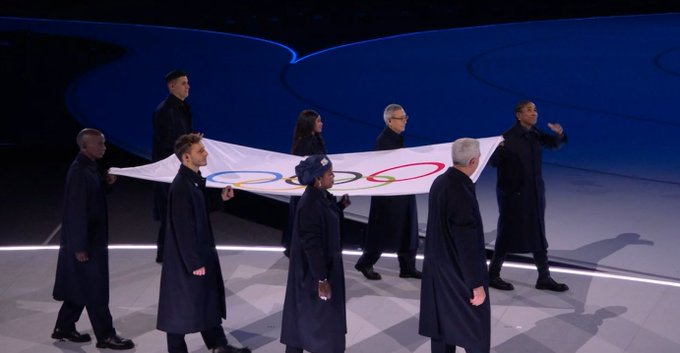
The Milano Cortina 2026 Opening Ceremony gave Nigeria a moment to remember when Maryam Bukar Hassan, the acclaimed poet known as Alhanislam, became the first Nigerian to carry an Olympic flag.

While athletes paraded behind their national colours, the Olympic flag—symbolic of global unity, cultural dialogue, and tireless advocacy—was reserved for those who embody these ideals. Sharing the spotlight with sporting icons like marathon legend Eliud Kipchoge and gymnastics star Rebeca Andrade, Maryam’s inclusion marked a rare and historic honor.


Clad in a bespoke Giorgio Armani ensemble that perfectly captured “Quiet Luxury,” Maryam entered Milan’s legendary San Siro stadium—not as an athlete, but as a UN Global Advocate for Peace. The weight of the flag, she noted, symbolized philosophy over fabric. “Carrying the flag ultimately meant recognising that peace is not an event, but it is practice,” she reflected. “It is a daily decision for us to humanise before politicising.”
Through her Instagram, Maryam offered fans a glimpse of her Italian journey—a montage of high-fashion moments, quiet reflection, and raw emotion. From thoughtful pauses beneath the Gothic grandeur of the Duomo di Milano to backstage anticipation, the video captures the gravity of the historic occasion.
“The roar of the 70,000-strong crowd gave me goosebumps,” she recalled. “When they called my name, you could feel the energy, the love, the adrenaline. It was such a beautiful moment.”
As Alhanislam, Maryam has spent years using spoken word to dismantle stereotypes and advocate for education, particularly for girls in Nigeria. Her walk in Milan amplified that mission on a global stage. Speaking to young girls across the country, she urged: “Regardless of the barriers that you’re facing… if you just stay at it, if you leverage the resources around you—your art, your pen, your voice—the world will hear you.”
Critics and cultural commentators have praised the International Olympic Committee for recognizing that global impact is not always measured in medals, but in the courage to speak truth to power. For Maryam, the stadium was more than a sporting arena—it was “a rehearsal space for coexistence,” where culture and conflict yield to shared humanity.
Reflecting on her transformative experience, Maryam leaves Milan with a stirring message for her compatriots: “Whenever you step outside of Nigeria, be Nigeria. You are Nigeria. You can be the change you want to see.” What began as a poetic journey culminated in a historic stride, cementing Maryam Bukar Hassan not just as a poet, but as a living piece of history.