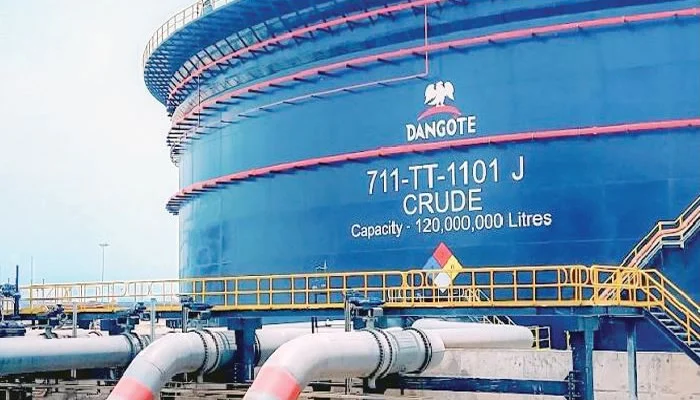
The Federal Government, through the Nigerian National Petroleum Company Limited, has begun efforts to secure crude oil for the Dangote Petroleum Refinery from international third-party traders to sustain local refining operations.
Industry sources said the move is aimed at ensuring a steady supply of crude to the Lekki-based refinery amid supply challenges. However, officials warned that the intervention may not immediately lead to a reduction in petrol prices.


Nigeria has recently witnessed several increases in petrol prices, with gantry prices rising from about N774 to N995 per litre. As a result, pump prices in many states have climbed above N1,000 per litre, with some stations selling fuel for as high as N1,200 per litre.
Oil marketers also confirmed that the Dangote refinery temporarily halted the loading of Premium Motor Spirit (PMS), a development that raised concerns that another fuel price increase could occur soon.
The situation has been worsened by rising global crude oil prices linked to tensions in the Middle East, particularly the conflict involving Iran and the United States. The crisis has pushed global oil prices higher and affected supply routes through the Strait of Hormuz.
According to industry data, Nigeria’s crude imports from the United States rose sharply to 41.13 million barrels in 2025, compared with 15.79 million barrels in 2024, showing the country’s growing reliance on imported crude to support refining.
Sources at the Dangote refinery said the plant currently receives about five crude cargoes monthly from NNPC, which is below the 13 cargoes required under the government’s naira-for-crude policy. As a result, the refinery has been forced to import additional crude at international market prices.
Industry experts say that while increasing domestic refining could help stabilise petrol prices, global oil market volatility and reliance on imported crude may continue to influence fuel costs in Nigeria.
Despite the challenges, analysts noted that the operation of the Dangote refinery has helped reduce the pressure on fuel supply. Without the refinery, they said petrol prices in the country could have risen to about N1,500 per litre.
Meanwhile, the refinery has expanded its list of petroleum marketers allowed to lift fuel from the facility, increasing the number from 13 to more than 30 companies, including NIPCO Plc, MRS Oil Nigeria Plc, TotalEnergies Marketing Nigeria Plc, and Conoil Plc. The move is expected to improve fuel distribution across the country.