Leaders of Ethiopia’s Tigray region have renewed their call to fully implement the 2022 Pretoria peace agreement, which ended the two-year conflict between Ethiopia’s federal government and Tigray forces.
During the weekend’s African Union (AU) Summit in Addis Ababa, the region’s two main political leaders, despite their rivalry, jointly urged the AU to ensure that all aspects of the agreement are enforced.


The AU-brokered deal, signed in November 2022, called for an end to hostilities, disarmament, the return of internally displaced persons, expedited humanitarian aid, and the restoration of essential services. While the agreement has led to some progress, including the partial return of social services, Tigray leaders insist that key provisions remain unfulfilled.
The first phase of the Disarmament, Demobilization, and Reintegration (DDR) program began just over two months ago, targeting 75,000 Tigray combatants as part of a broader initiative to demobilize 371,971 fighters across Ethiopia. However, Tigray officials argue that the process has focused too heavily on disarmament while neglecting the reintegration of former fighters into society.
Getachew Reda, President of the Tigray Interim Regional Administration, stressed the importance of following through with the entire DDR process, not just the initial disarmament phase. “Where we disarm should not be the end,” he said. “The AU and international community must ensure that former combatants are properly demobilized and reintegrated into society.”
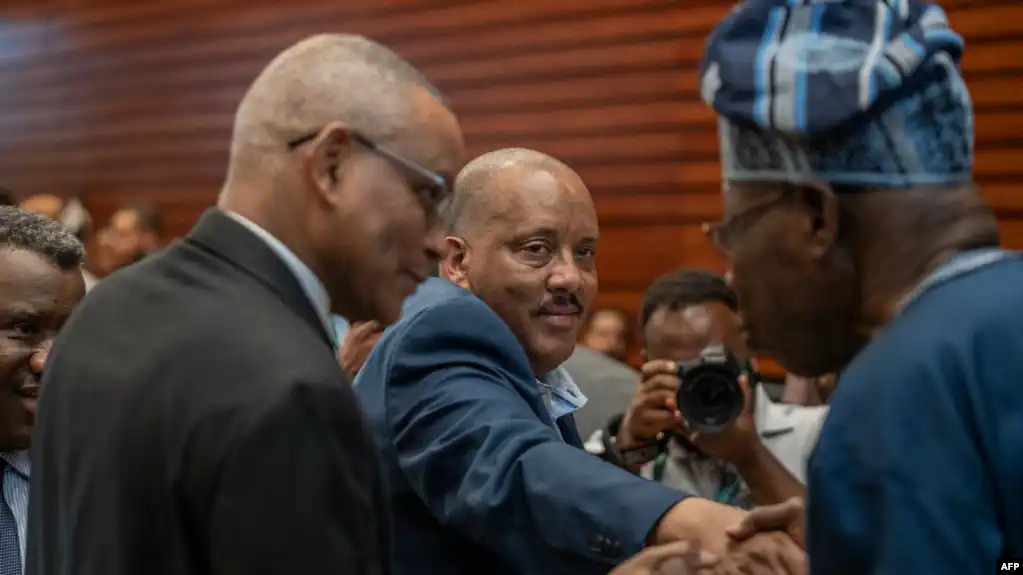
Meanwhile, TPLF leader Debretsion Gebremichael highlighted other unaddressed issues, including the return of occupied territories and the resettlement of displaced persons. “The cessation of hostilities was a significant milestone, but there are still critical components left unimplemented, such as the constitutional restoration of occupied territories and the withdrawal of non-ENDF forces,” he stated.
The “non-ENDF forces” he referred to are Eritrean and Amhara regional forces, which fought alongside the Ethiopian National Defense Force (ENDF) during the conflict. While Eritrea denies having troops inside Ethiopian territory, the Ethiopian government has stated that the issue of Western Tigray’s status will be settled through a referendum.
Ethiopian Minister of Foreign Affairs, Gedion Timothewos, reaffirmed the government’s commitment to implementing the agreement through “constructive engagement” and adherence to the rule of law. He assured the AU that “with good faith implementation, the remaining outstanding issues can be resolved.”
AU chief negotiator and former Nigerian President Olusegun Obasanjo acknowledged the concerns but urged all parties to proceed with the phased approach outlined in the agreement. He emphasized that unresolved issues should not derail the broader implementation process, calling the Pretoria agreement a testament to the principle of “African solutions to African problems.”
Despite their public show of unity at the AU event, Tigray’s two key political figures—Getachew Reda and Debretsion Gebremichael—are locked in a bitter power struggle that has crippled regional governance.
Their dispute centers on the implementation of the Pretoria agreement, with Debretsion accusing Getachew of failing to defend Tigray’s interests, a claim Getachew strongly denies. The rift escalated in August 2024 when the TPLF expelled 15 central committee members, including Getachew, a move he described as “null and void.”
Getachew, in turn, accused the TPLF leadership of attempting a “coup d’état” against his administration, while the TPLF leveled the same charge against him. Tensions intensified last month when over 200 Tigray security force commanders, who had remained neutral for months, declared their support for Debretsion, accusing Getachew of betraying the region’s cause.
The National Election Board of Ethiopia (NEBE) further complicated the situation by suspending the TPLF from political activities for three months, citing its failure to hold a general assembly. The TPLF rejected the decision, accusing the board of undue interference.
“As a signatory to the Pretoria agreement, we assert that the board is meddling in our affairs,” the TPLF said in a statement. “We urge the federal government to ensure that, if any instability arises, responsibility lies with the election board.”
Ethiopian Prime Minister Abiy Ahmed has called on Tigray’s political elite to resolve their differences through dialogue, urging that all disputes—whether internal or with the federal government—be addressed within the framework of the national constitution.
As tensions persist both within Tigray’s leadership and between the region and the federal government, the fate of the Pretoria peace agreement remains uncertain. While Ethiopian officials insist that progress is being made, Tigray leaders argue that key provisions must be fully implemented to ensure lasting peace. The AU and international community now face the challenge of mediating both the peace process and the internal divisions threatening Tigray’s fragile stability.