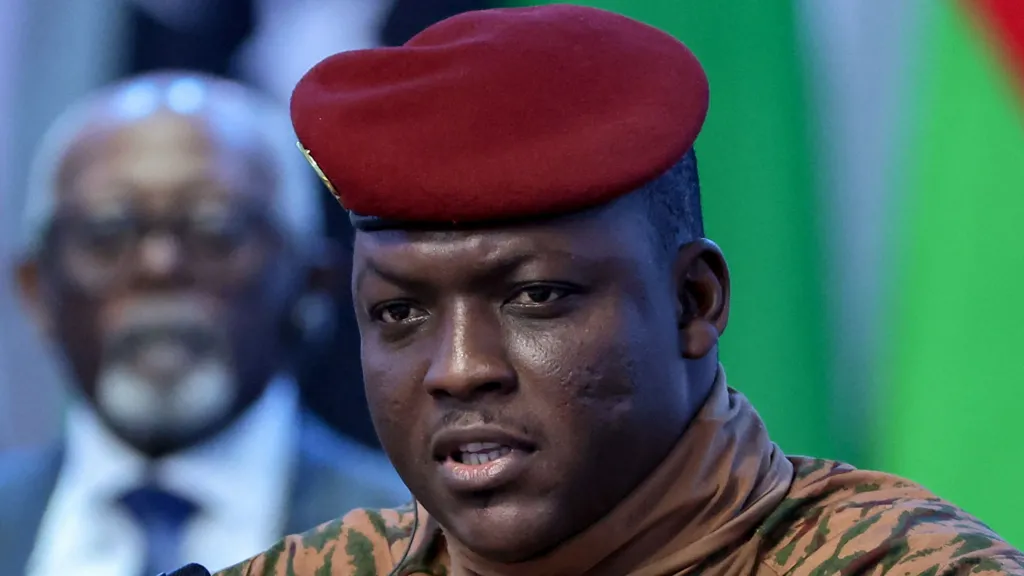
Burkina Faso’s military ruler, Ibrahim Traoré, has dismissed democracy as unsuitable for the country, urging citizens to “forget” the system in favour of what he described as a new, homegrown approach.
In an interview aired on state television, the 38-year-old leader argued that democracy often leads to instability and violence, citing examples from other regions. “People need to forget about the issue of democracy. Democracy is not for us,” he said, adding that attempts by Western powers to impose democratic systems have frequently resulted in bloodshed.
Traoré, who seized power in a 2022 coup, had initially promised a return to civilian rule by July 2024. However, his administration later extended the transition period by five years, consolidating military control. In January, authorities also announced a ban on all political parties as part of efforts to “rebuild the state.”
During the interview, the junta leader criticised political parties, describing them as divisive and incompatible with his government’s revolutionary agenda. He portrayed politicians as self-serving and untrustworthy, while insisting that Burkina Faso would chart its own political path without replicating foreign systems.
Although he did not outline a detailed alternative, Traoré said his administration was focused on creating a system rooted in sovereignty, patriotism, and grassroots mobilisation, with traditional institutions playing a central role.
He also emphasised the need for economic and military self-reliance, urging citizens to adopt a stronger work ethic as part of efforts to accelerate national development.
Despite his rhetoric, Traoré’s government has faced criticism over its human rights record. Rights groups have accused the junta of suppressing dissent, targeting opposition figures, and restricting media and civil society activities. There have also been allegations that critics are being forced to the front lines of the country’s ongoing conflict with Islamist militants.
A recent report by Human Rights Watch stated that more than 1,800 civilians have been killed in Burkina Faso since Traoré took power in 2023, with the majority of deaths attributed to government forces and allied militias.
Burkina Faso, alongside neighbouring Mali and Niger, has shifted away from traditional Western allies, particularly France, in its fight against insurgents. The three countries have instead strengthened ties with Russia for military support, although the security situation in the region remains volatile.
Despite mounting criticism, Traoré continues to enjoy significant support among segments of the population and across Africa, largely due to his pan-Africanist stance and opposition to Western influence.