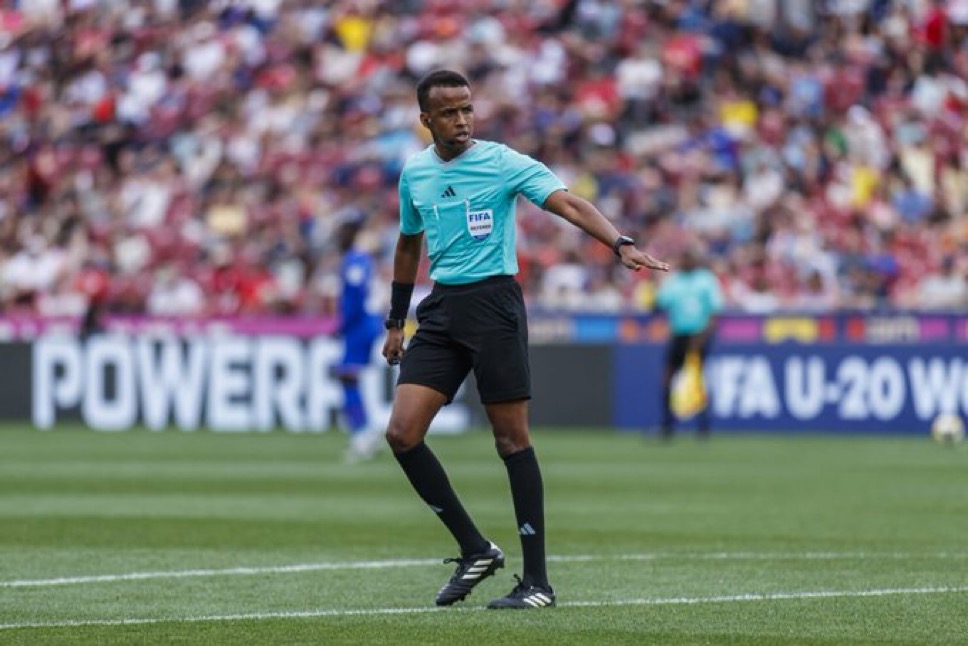
A leading Somali football referee, Omar Artan, has been denied entry into the United States ahead of the FIFA World Cup, raising fresh concerns over the impact of Washington’s travel restrictions on the global tournament.
The United States Department of Homeland Security (DHS) confirmed that Artan was refused entry after arriving in South Florida on Saturday, despite being selected as one of FIFA’s 52 referees for the competition.


In a statement, DHS said Artan was found inadmissible following a vetting process but did not disclose specific reasons for the decision.
Artan, regarded as one of Africa’s top football officials, had been set to make history as the first Somali referee to officiate at a FIFA World Cup.
The development has reignited debate over US immigration policies, particularly as Somalia remains on a travel restriction list implemented by President Donald Trump’s administration.
The incident is the latest travel-related challenge affecting World Cup participants. Iran’s national team has also faced visa complications, with some members of its delegation reportedly denied entry to the United States.
Civil rights organisations have criticised the decision. The Council on American-Islamic Relations (CAIR) described the move as discriminatory and argued that nationality should not be a basis for excluding individuals participating in an international sporting event.
The DHS, however, maintained that all admissibility decisions are made on a case-by-case basis using immigration, law enforcement and national security information available at the time of inspection.
“CBP officers have the authority to question travellers, conduct inspections and determine admissibility consistent with US law,” a department spokesperson said.
The controversy comes as the United States prepares to host a significant portion of the World Cup alongside Canada and Mexico, with concerns growing over the effect of immigration policies on players, officials, staff and supporters travelling to the tournament.
Artan had previously spoken of the challenges he overcame to reach football’s highest stage, including working as a referee amid security threats and instability in Somalia.
“You have to continue, and you have to fight if you want to go to a place like the World Cup,” he said in an earlier interview.