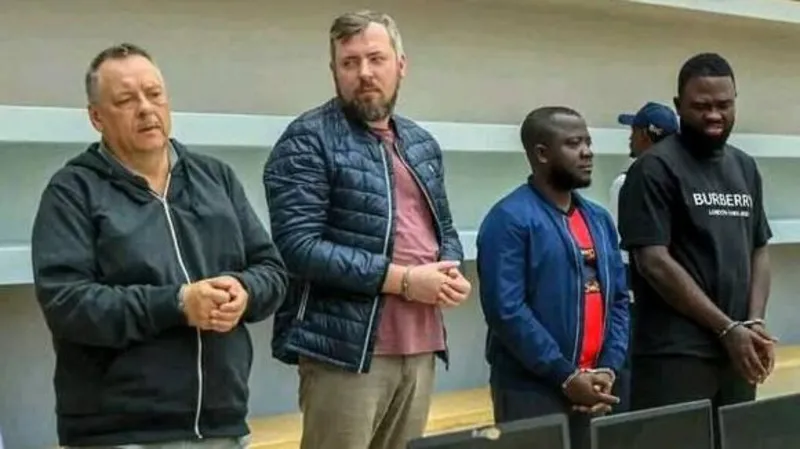
An Angolan court in Luanda has convicted two Russian men of terrorism, espionage and related charges, handing down prison terms of 11 and 8 years.
Political consultant Igor Ratchin received 11 years. Translator Lev Lakshtanov was sentenced to 8 years. Both had pleaded not guilty.

They were arrested in August 2025 and accused of helping to stir anti-government protests, running a disinformation campaign, and trying to influence Angola’s presidential election set for next year.
Court documents seen by the BBC allege the pair were linked to Africa Politology, which Angolan authorities describe as a Russian political network that grew out of the former Wagner mercenary group. Prosecutors said the group aimed to spread anti-Western messaging and build political contacts in Angola.
Ratchin and Lakshtanov denied any ties to Wagner or the Russian state. They told the court they were working to open a Russian cultural center in Luanda. Their lawyers had asked for extradition to Russia under a bilateral agreement. It is not clear if the court granted that request.
Two Angolans were tried alongside them. Sports journalist Amor Carlos Tomé got a two-year suspended sentence. Political activist Francisco Oliveira was acquitted. Prosecutors have appealed both outcomes. Tomé is expected to stay in custody while the appeal proceeds.
The indictment said the defendants paid more than $24,000 to local journalists and analysts to publish pro-Russian and anti-government material, and cited notes, photos and messages about 2025 protests found on their devices. Defense lawyers argued the case relied on assumptions, not concrete proof. They also objected when the prosecutor declined to read the indictment aloud at the start of the trial in March.
During hearings reported by Angolan outlet Novo Jornal, Lakshtanov said he had lived in Angola for nearly 40 years and that his academic background did not fit with terrorism. Ratchin said he was a businessman and that payments were for services, not politics.
Their lawyer, Elizeu Nguiniti, said after the verdict he disagreed with the ruling on four of 11 charges: criminal association, espionage, terrorism and illegal holding of currency. He added that he accepts the court’s decision.
The Russian embassy in Angola had not responded to the BBC’s request for comment at the time of publication.
Angolan activists have pushed back against the claim that 2025 protests were orchestrated from outside, saying they began organically.
Russia-linked political operatives have been active in several African countries for more than 10 years, including in the Central African Republic, Mali and Madagascar.