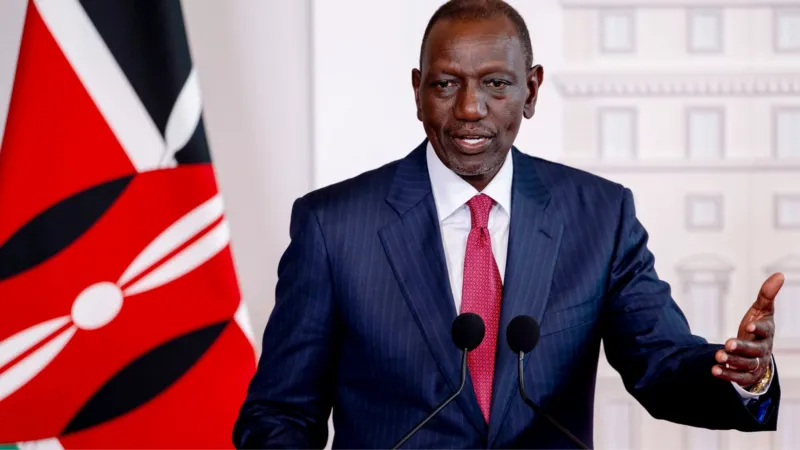
Kenya’s President William Ruto has walked back his recent remarks suggesting Nigerian-accented English was incomprehensible, saying his comments were private and “taken out of context.”
His clarification came at a mining conference in the Kenyan capital, Nairobi, attended by Nigeria’s Minerals Minister Henry Dele Alake, who told the gathering: “President Ruto, the people of Nigeria have mandated me to inform and assure you that Nigerians speak good English.”


To much laughter, Ruto took to the stage to explain his comments to Kenyans living in Italy last week.
“The fact is that I was talking about how we in Africa speak very good English, all of us,” he said.
“In fact, in some countries like Nigeria, if you do not speak excellent English like the one we speak in Kenya, you may need a translator to understand the excellent English of Nigeria. So that was the comparison. But somebody misrepresented the facts.”
President Ruto reminded the audience that Nigerians were his in-laws — one of his daughters, June, is married to a Nigerian.
“I want to send my regards to my brothers and sisters in Nigeria… my in-laws.”
He told Alake to pass on his greetings to Nigerian counterpart Bola Tinubu: “Tell President Tinubu that I said, ‘Hi’. And tell him I said that in good English… so that there will be no consequences.”
Following an explanation about how he felt he had been misrepresented, the president ended by saying: “It is as well that we can have this conversation — my in-laws I hope there will be no consequences for whatever was done.”
The good-natured banter was in sharp contrast to a barrage of criticism President Ruto has faced online.
Last week, he had boasted about how Kenya’s education system was producing some of the best human capital in the world, with strong English proficiency.
“We speak some of the best English in the world, that is true. If you listen to a Nigerian speaking, you don’t know what they are saying. You need a translator even when they are speaking English.”
The condemnation that followed was widespread, fuelling an online rivalry between the two nations.
Kenya and Nigeria are both former British colonies and share English as an official language but have distinct spoken varieties with different phonetic structures.
These differences reflect the influence of indigenous languages — Nigeria has more than 500 languages which shape its cadence and intonation, while Kenya’s Bantu, Nilotic and Cushitic mix give rise to its own accents.