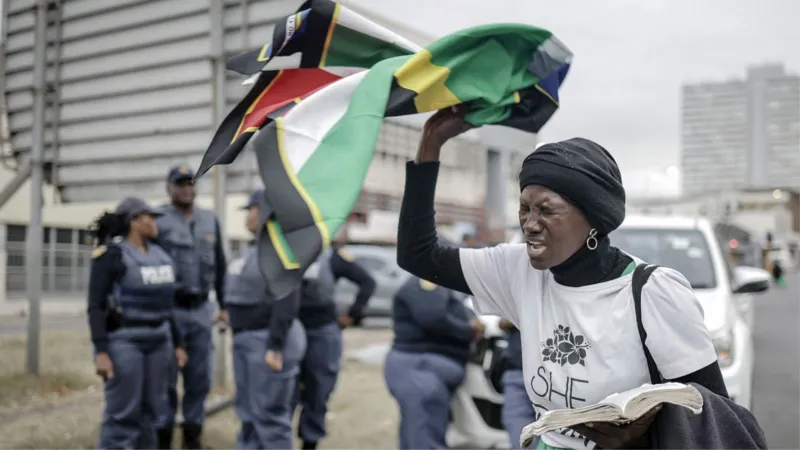
South Africa is on high alert with a heavy police presence in major cities ahead of planned anti-migrant demonstrations.
Officers were mobilized nationwide after organizers set an unofficial deadline for undocumented foreigners to leave. President Cyril Ramaphosa urged participants to protest peacefully and avoid “intimidation, threats or ultimatums,” noting that many foreign nationals live and work in the country legally and deserve constitutional protection.

In Johannesburg, where one march is planned, streets were unusually quiet. Shops near the gathering point closed and police patrolled main roads. Authorities say 5 people were arrested in Soweto for allegedly looting a foreign-owned shop, and 5 more in Hammarsdale, KwaZulu-Natal, for breaking into a tuck shop. Many businesses in central Durban also shut their doors.
The protests stem from frustration over undocumented migration. Official data shows more than 3 million documented foreign nationals in South Africa, with the number of undocumented migrants unknown. Police report that 25,000 people have already been repatriated, most from other African countries.
At a transit camp in Durban, many Malawian migrants were preparing to leave. Women sat with their belongings, waiting for buses home. Nelson Mbewe said he came to find work but was told to return because he lacked papers and faced the slur “Makwerekwere.” Another migrant, Hassan Phiri, appealed for unity: “Africa must remain Africa… we must love each other and stick together.”
Ramaphosa’s government says over 12,000 immigrants have been deported or repatriated since protests began earlier this year. Countries including Ghana, Malawi, Mozambique, Nigeria, and Zimbabwe have arranged air and bus repatriations for about 3,500 volunteers.
Organizers have been authorized to march Tuesday in Durban, Johannesburg, and other cities. Police warned that traditional weapons like shields, whips, and sticks — often carried by Zulu protesters — are prohibited and could cause clashes.
Xenophobia has long fueled tension in South Africa. The African Centre for Migration and Society recorded 2 xenophobic killings this year. In 2008, more than 60 people died in anti-foreigner riots.
Ramaphosa acknowledged the need for immigration reform but stressed: “The right to protest… does not allow people to threaten or intimidate others, or to engage in acts of vandalism or violence.”