The Federal Competition and Consumer Protection Commission has clarified that it has not banned airtime borrowing or data advance services in Nigeria amid widespread confusion triggered by viral social media posts,
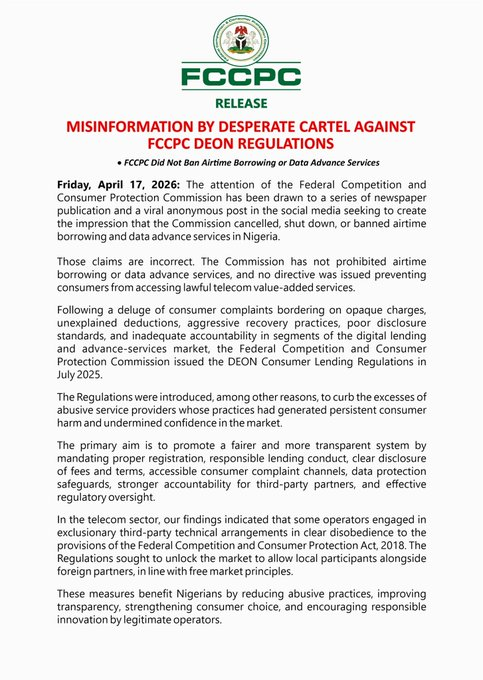
In a statement released on Friday via its official X handle, the Commission described reports suggesting a ban as false and misleading, stressing that no directive has been issued to restrict access to lawful telecom value-added services.


“The Commission has not prohibited airtime borrowing or data advance services, and no directive was issued preventing consumers from accessing lawful telecom value-added services,” the statement said.
The FCCPC explained that the misunderstanding stems from regulatory measures introduced in July 2025 under the DEON Consumer Lending Regulations. These rules were implemented in response to rising consumer complaints, including hidden charges, unexplained deductions, aggressive debt recovery tactics, poor disclosure practices, and weak accountability among some service providers.
Rather than banning services, the Commission said the regulations were designed to promote transparency and fairness. Operators are required to register properly, clearly disclose fees and terms, adopt responsible lending practices, and provide accessible channels for consumer complaints.
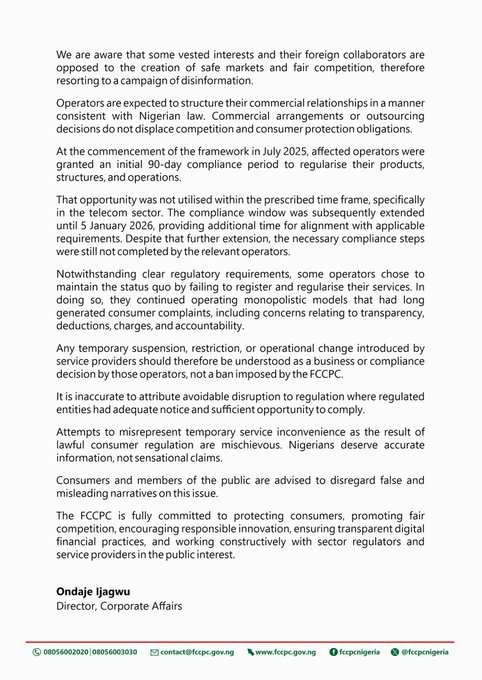
The Commission also noted that some telecom operators had engaged in anti-competitive practices, including exclusionary agreements with third-party providers, in violation of the Federal Competition and Consumer Protection Act, 2018. The new framework, it said, aims to open up the market and encourage fair competition.
According to the FCCPC, operators were initially given a 90-day window to comply with the new regulations, which was later extended to January 5, 2026. However, some providers failed to regularise their operations within the deadline and continued practices that had attracted complaints.
The regulator emphasised that any temporary suspension of airtime or data borrowing services should be seen as a business or compliance decision by telecom operators, not a directive from the Commission.
It also warned against deliberate misinformation aimed at undermining ongoing reforms in the sector and urged Nigerians to rely on verified information regarding telecom services.